

A reflection on study as a spiritual discipline
The Revd Jane Maycock
Fourth week of Lent 2023
A few years ago I went to Malta for the first time. It was a special holiday for my husband’s birthday, and the first time we had been on a holiday abroad which wasn’t a visit to family or friends. It was a mix of rest, relaxation and exploring new places. One of those places was Valletta, and among other places, its Co-Cathedral of St. John. It was built in the 1570s, its plain exterior giving way to the shocking exuberance of the Baroque decor inside. Every inch of stone, floor to ceiling, wall to wall, is extravagantly ornate. It’s hard not to conclude that those responsible for the decor of the various chapels were vying with each other for prominence in their display of wealth of ornamentation. Even the ceiling is ornate, covered in paintings depicting scenes from the life of John the Baptist, in what I feel to be a rather florid style.
After all of that it was a relief to turn the corner, enter Oratory and find myself facing the beheading of John the Baptist (not something I anticipate saying very often). By ‘the beheading of John the Baptist’ I do of course mean the painting by Caravaggio which hangs in this spacious side chapel of the Baroque extravaganza, mercifully lacking the architectural ornamentation that the characterises the rest of the building. I remember walking towards this painting, drawn by it’s light and shadow, by it’s shocking depiction of the brutal and mundane side by side. Turning my back on that scene I found myself facing a second Caravaggio: St. Jerome writing.
A less brutal scene? Well yes, but more serene? I think not. Caravaggio’s characteristic use of light and deep shadow does not make for serenity, the depths are too great and the light too bright, contrasts which seek to pull our attention in different directions at the same time.
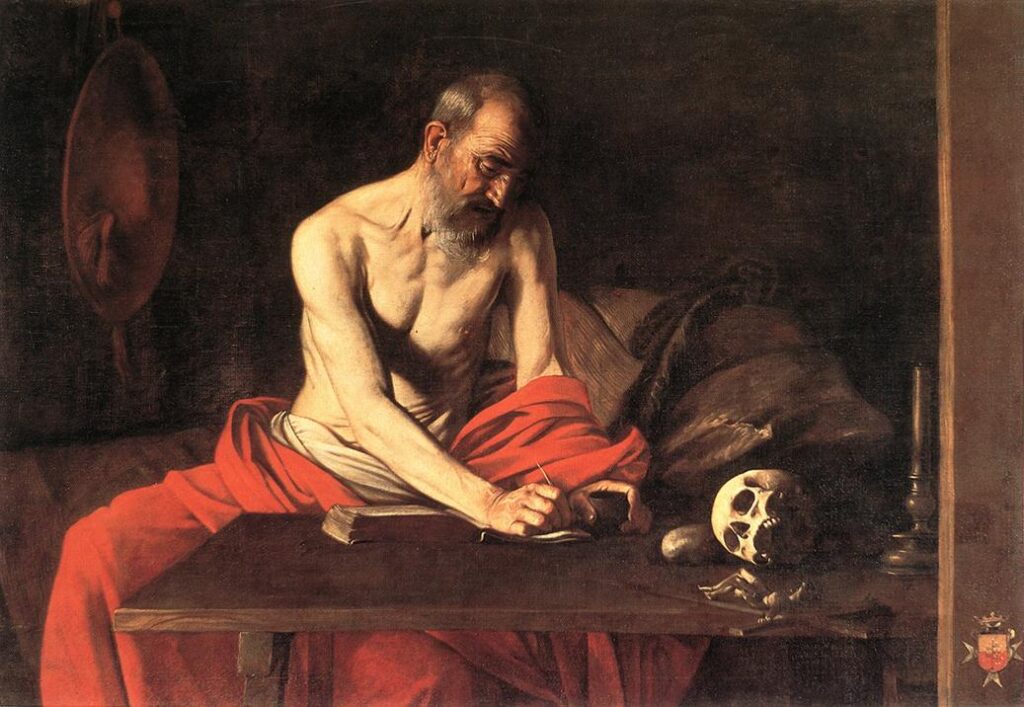
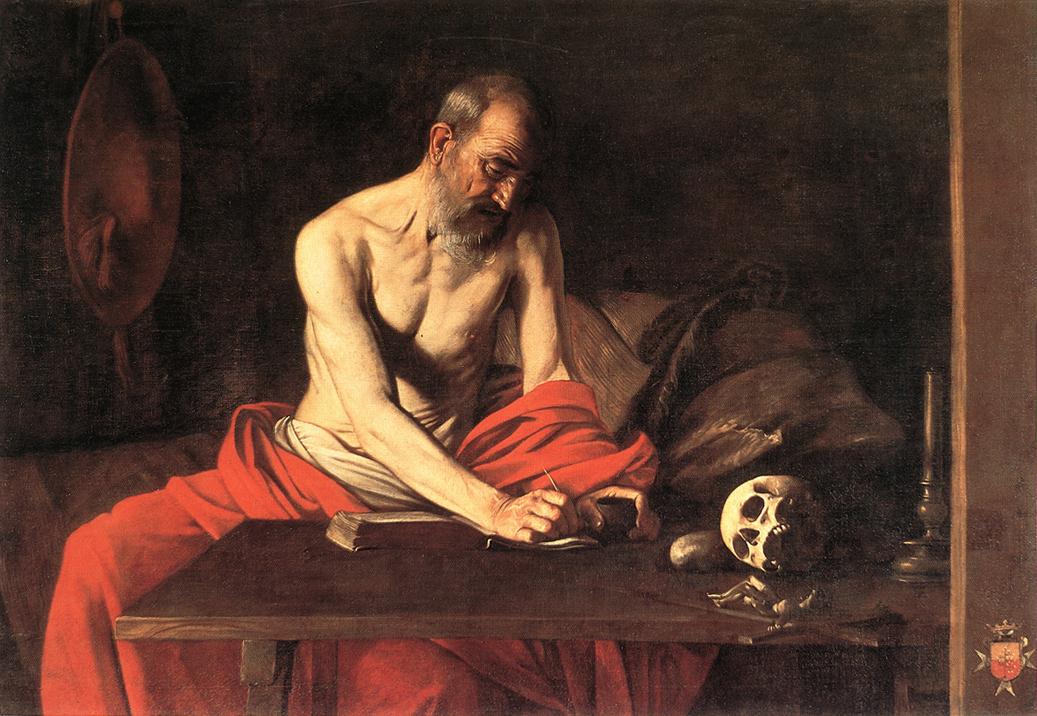
Traditionally St. Jerome was often portrayed with a red cardinal’s robe and cardinal’s hat (even though the office of cardinal did not come into being until later). In this depiction Jerome is seated on the edge of a bed, with a small table in front of him of a similar height. He is naked to the waist, the lower half of his body draped in the red robe which has probably slipped from his shoulders, a loin cloth just visible at his waist. One arm is outstretched, resting on the open book lying on the table in front of him, holding a slender pen or stylus. The light comes from the left of the picture as the onlooker views it, illuminating the right side of his face. He is looking down, intent on what he is writing. There is a strong sense of stillness. In the deep shadow to the left his hat hangs on the wall — clearly not required by the figure whose attention lies in the opposite direction. His face does have a serenity about is, a sense of composure, of focus.
We might think that was it, and it could be enough. Jerome was renowned as a scholar and prolific writer, most famously perhaps as the translator of the Vulgate latin Bible. Yet Caravaggio wants us to see more than simply the scholar at his work. His stillness, his concentration, his intent, all invite us to reflect on our own practice of studying. Have think for a moment: where do you do your praying? Where do you do your studying? And your writing? What do you have on your desk — a computer monitor? A mug of tea or coffee? A pile of books? A notebook or loose sheets of paper with jotted notes? Perhaps your desk is the kitchen table, or may be you prefer to sit on the sofa with your laptop on your knees. Caravaggio draws our attention to the things that furnish St. Jerome’s writing space: a skull, a crucifix and an unlit, dark wax candle. The white of the skull is illuminated by the light coming from Jerome’s right, it’s eyeless sockets cast into deep shadow as it lies ‘facing’ the light. The crucifix is not hanging but lying in front of the skull and in front of Jerome. The candle stands in the shadow to the side, unlit and apparently not required. The light that illuminates Jerome comes from elsewhere.
Paintings are often more eloquent than words and this is no exception. In one sense there is not much in the picture: one man and a table with a few things on it. Yet the depths that we are invited to attend to are held within a roughly triangular shape, formed by line and colour. The base of the triangle is formed by the edge of the table. Our eye then follows the line from Jerome’s right knee across his right shoulder to the crown of his head, the apex of the triangle. Whilst his gaze drops to what he is writing, the remaining side of the triangle is formed by the way the tilt of his head draws our eyes towards the skull on the table. And there it is: a reminder that the context within which we study is human mortality, laid side-by side with a reminder of our redemption through the death of Jesus Christ.
However you choose to furnish your study space, it is your inner disposition that matters. Whether or not your Lenten discipline includes the imposition of ashes on Ash Wednesday, the words that go with that should ring in our ears throughout the season. They are the words so eloquently conveyed here by Caravaggio in his presentation of St. Jerome writing: “Remember that you are dust and to dust you shall return. Turn away from sin and be faithful to Christ.”
However you choose to furnish your study space,
it is your inner disposition that matters.
Published 22 March 2023


